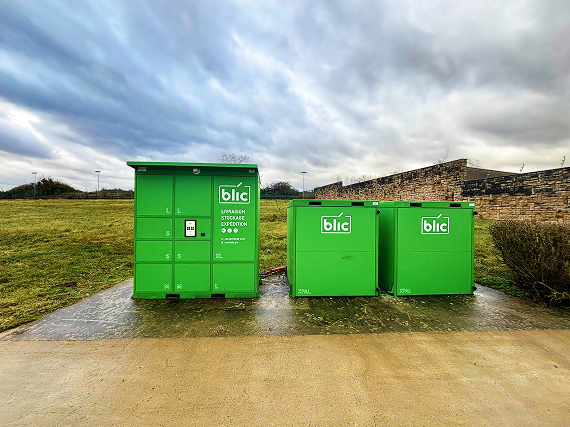
They are typically installed in unattended and public-facing settings, where reliability, availability, and predictable behavior are critical to daily operation.
Within two terminal solutions in BLIC’s portfolio, the BLIC Master 9 and BLIC XGate, a touchscreen is used as the primary user interface for operating the terminals. As the single point of interaction between user and system, the display directly affects usability, throughput, and system availability. After testing and prototyping, BLIC selected the Beetronics 12HB9M touchscreen monitor for these platforms, but what considerations led to this choice, and how did the selection process take shape?
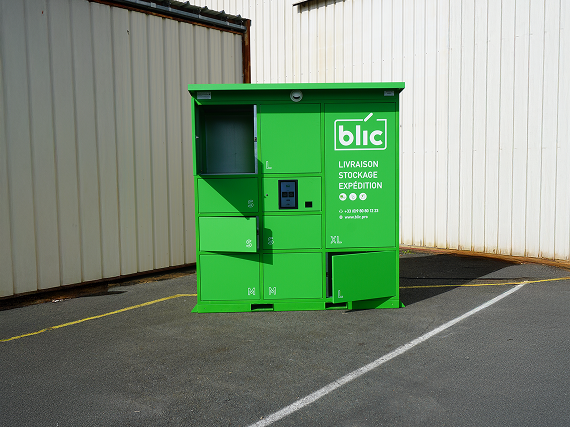
Access and Payment Terminals for Public and Controlled Environments
Based in Lyon, France, BLIC develops and manufactures terminal solutions for demanding environments such as parking facilities, gated sites, industrial locations, and public infrastructure. These terminals are often installed in public or semi-exposed locations, where they are expected to operate continuously with minimal supervision while remaining intuitive for a wide range of users.
Both the BLIC Master 9 and BLIC XGate are designed specifically for unattended operation. The terminals guide users through access authorization, identification, and payment workflows without human intervention. In this context, the touchscreen functions as the primary machine interface and the only interaction point between user and system. Any loss of responsiveness, visibility, or stability does not only affect user experience, but can lead to failed transactions, blocked access, and operational intervention.
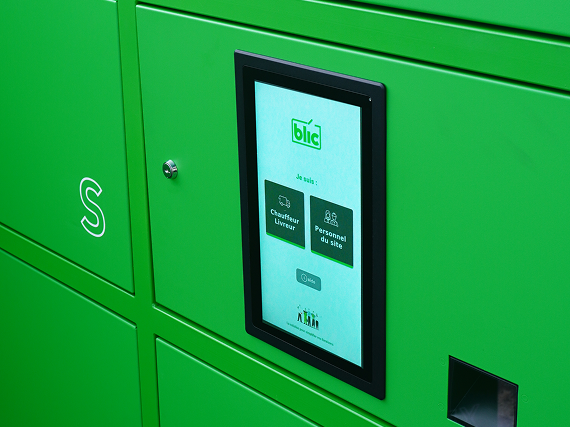
Selecting a Touchscreen for Unattended Operation
Because the touchscreen defines how users interact with the terminal, BLIC placed strong emphasis on selecting a display suitable for continuous, unattended use. In access and payment systems, display-related failures can render an otherwise functional terminal unusable. In public and outdoor installations, this directly translates into downtime, service calls, and disruption of access flows.
During the evaluation phase, BLIC tested multiple touchscreen options under conditions representative of real-world operation. Display brightness, touch accuracy, mechanical robustness, and long-term stability were assessed alongside integration requirements and enclosure constraints. The selection process focused not only on initial performance, but on predictable behavior over time. Based on these evaluations, BLIC selected the Beetronics 12HB9M touchscreen monitor for use across both terminal platforms.
The 12HB9M is a 12-inch high-brightness touchscreen designed for demanding environments. It features a vandal-resistant front panel, UV filtering, and support for wide operating temperature and humidity ranges. These characteristics support stable and repeatable performance in unattended installations, reducing the risk of unexpected behavior under varying environmental conditions.
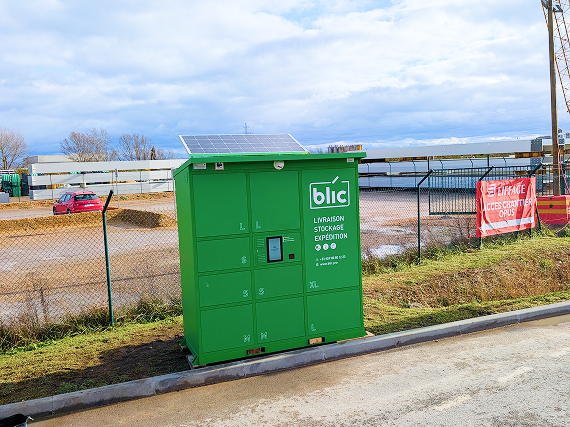
Readability and Durability in Outdoor and Semi-Outdoor Installations
Access and payment terminals are exposed to changing ambient light conditions, temperature fluctuations, and intensive daily use. In such environments, insufficient display brightness or mechanical weakness can compromise usability and accelerate wear.
By integrating a high-brightness touchscreen, BLIC ensures that terminal interfaces remain readable in bright daylight and consistent across different installation conditions. The touchscreen is integrated into sealed terminal enclosures, supporting long-term operation in outdoor and semi-outdoor installations where resistance to exposure, vandalism, and mechanical stress is required.
A Standardized Touchscreen Platform Across Terminal Solutions
Although the BLIC Master 9 and BLIC XGate serve different access scenarios, both terminals are built on the same touchscreen architecture. By standardizing on the Beetronics High-Brightness displays across these platforms, BLIC achieves consistent interaction behavior and predictable system performance across its terminal lineup.
This standardized approach reduces engineering complexity, limits configuration variance, and simplifies maintenance and support. It also enables future terminal variants to be introduced without redesigning the core user interface layer, reducing validation effort and deployment risk for both BLIC and its customers.
Supporting Scalable Deployment and Long-Term Availability
Access and payment infrastructure is typically deployed over extended periods and across multiple locations. Hardware consistency and long-term availability are therefore critical to maintaining operational continuity. Component changes can require redesigns, software revalidation, or adjustments to enclosure design, all of which introduce cost and risk.
By selecting a touchscreen platform with stable specifications and long-term availability, BLIC can expand existing installations while maintaining technical and visual consistency. New terminals can be deployed alongside existing systems without changes to the user interface, enclosure design, or system validation process.
Ongoing Deployment of Access and Payment Solutions
With a large installed base already in operation and new deployments added each year, BLIC continues to expand its access and payment infrastructure across a wide range of applications. The use of a standardized touchscreen platform supports controlled scaling, predictable system behavior, and long-term maintainability in environments where availability and reliability are non-negotiable.